
Brush or Comb? What Each Tool Is Actually For

Ask ten bearded men whether they use a brush or a comb and you will get ten confident answers, most of them accidents of whatever they bought first. That is a shame, because the two tools are not interchangeable — they are built for different work, they suit different lengths, and each rewards a technique that almost nobody is taught. Having spent a decade testing both, here is the honest division of labour.
What a brush is for
A proper beard brush — firm natural bristle, typically boar — does three jobs no comb can match. It distributes: bristles carry oil from the roots along every strand, which is why a brushed beard looks conditioned all over while an unbrushed one looks oiled in patches. It exfoliates, gently: the bristle tips reach the skin beneath and lift away the dry flakes that would otherwise become beard dandruff. And it trains: daily brushing in one direction genuinely teaches the hair to lie that way, which is the closest thing beard care has to a cheat code.
The brush is at its best on short to medium beards, and on any beard in the first ten minutes after oil goes in. It is a morning tool and an evening tool, and it works best on a beard that is dry or very nearly so — wet hair stretches, and dragging firm bristle through it is unkind.
On stiffness: firm bristle, not soft. A soft brush feels pleasant and achieves almost nothing on coarse facial hair, which is why so many men conclude that brushing is a myth — they have been polishing their beard rather than brushing it. The bristles should have enough spine to part the hair and touch skin at light pressure. Our Premium Beard Brush is set firm for exactly this reason, and the difference is obvious within a week of daily use.
What a comb is for
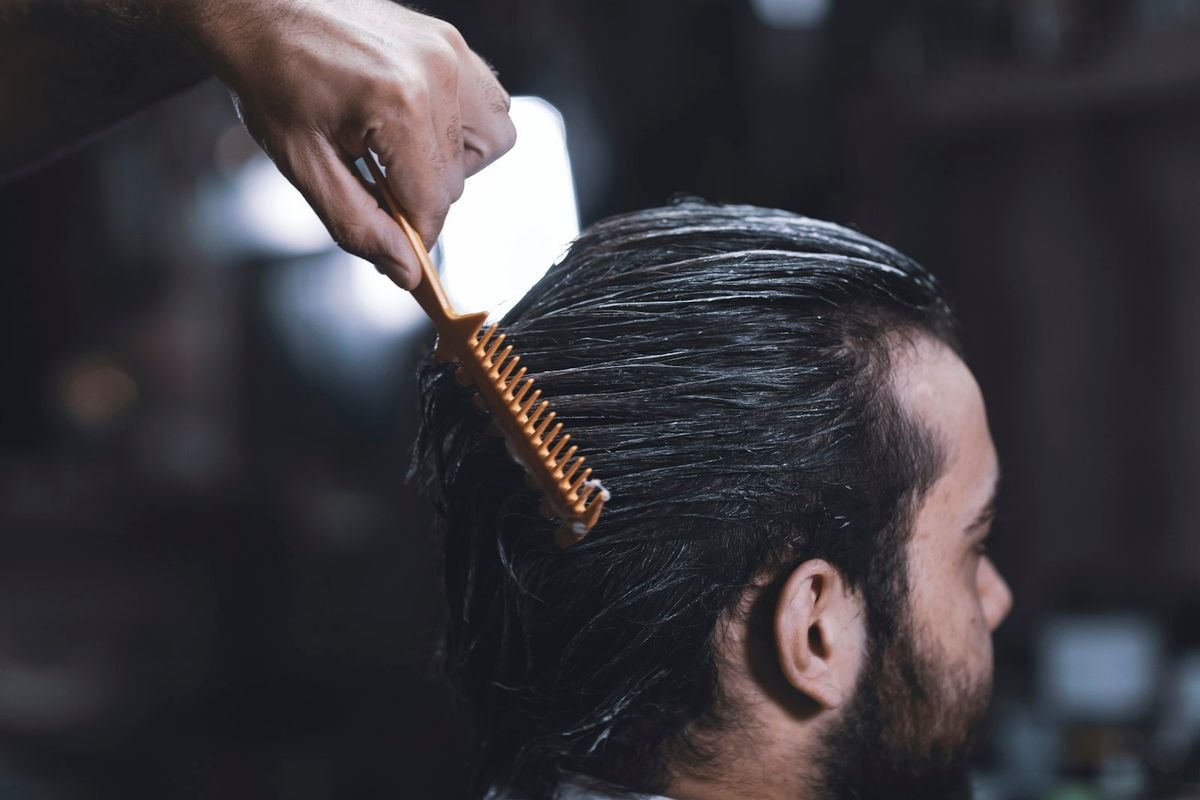
The comb takes over where the brush runs out of reach. Once a beard has real length — from roughly the third month — a brush skims the surface while the interior quietly mats. A comb gets inside the beard. It detangles, it sections, and above all it styles: a comb sets a parting, a direction, an edge, with a precision no brush can offer. It is also the tool for the moustache, where a brush is comically oversized, and the essential partner to scissors on trim day, when you will comb sections out and cut what stands proud of the teeth.
Look for sawn and polished teeth rather than moulded ones — cheap pressed-plastic combs have microscopic seams that snag and split hair. A wide-tooth end for detangling and a finer end for finishing covers everything. Our Premium Beard Comb is cut exactly on this pattern.
How to brush properly
- Work on a dry or barely damp beard, ideally a minute after applying oil.
- Start below the jaw and brush downwards and outwards, letting the bristles reach skin without scrubbing at it.
- Cover the beard in passes: left cheek, right cheek, chin, each three or four strokes.
- Finish the moustache outwards from the centre, and resist the temptation to over-brush — a dozen strokes a session is plenty.
How to comb properly
- Never rip through a tangle. Start at the ends of the beard and work upwards towards the roots, clearing knots from the bottom.
- Use the wide teeth first, always. The fine teeth are for finishing and the moustache, not for excavation.
- Hold the comb at a shallow angle and let the teeth glide along the jawline when setting shape — you are directing hair, not ploughing it.
- If the comb keeps catching, stop and ask why. A beard that fights the comb is usually a beard that needs washing, oiling or trimming, and the comb is just the messenger.
So which do you buy?
- Under three months of growth: brush only. A comb has nothing to hold onto yet.
- Three to six months: brush daily, comb for styling after balm and on trim days.
- Six months and beyond: both, daily. The brush maintains the surface and the skin; the comb governs the interior and the shape.
- Moustache of any ambition: comb, no argument.
The brush is husbandry, the comb is architecture. One keeps the beard healthy, the other keeps it deliberate.
Look after the tools
A good brush and comb should outlast several beards. Pull shed hairs from the brush weekly and wash the bristles in warm water with a drop of mild soap once a month, drying it bristle-down. Wipe the comb after use — it collects oil and balm residue that eventually transfers back as grime. Five minutes a month keeps both honest. And keep them out of the shower cabinet: constant humidity is what warps wooden combs and loosens brush knots, so a shelf outside the steam is the difference between tools that last two years and tools that last twenty.
Both our Premium Beard Brush and Premium Beard Comb are built to that outlast-the-beard standard, and you will find them alongside the rest of the range on the products page. Once you own the pair, put them to work in a proper sequence — the daily routine guide shows where each slots in, and when trim day comes around, the comb's finest hour is covered in our guide to scissor trimming at home.
Found this useful? Pass it on.